


Karakoram Expedition: A Guide's Journey Through Ladakh's untouched Shukpa Kunzang Valley
- TipToe Ladakh

- Jun 26, 2025
- 9 min read
❄️ A Journey into Ladakh’s Remote Mountains
In 2014, I joined a month-long expedition into one of the wildest corners of the Karakoram — the Shukpa Kunzang valley, a place so remote that much of its terrain remains unclimbed, unnamed, and unmapped. The expedition was organized by Rimo Expeditions, and the team I was leading consisted of 12 members from the Indian Air Force, whom I accompanied as one of their mountain guides.
The goal was ambitious: to attempt eight virgin summits over the course of a month.
We only made it to three.
But those three summits came with countless invisible peaks — of endurance, of survival, of awe.
🏔️ Climbing the Karakoram: What Makes This Mountain Range So Legendary
Straddling the borders of India, Pakistan, and China, the Karakoram range is one of the world’s greatest mountain systems — second only to the Himalaya in height but far more remote and severe in character. It is home to K2, the world’s second-highest mountain, as well as countless jagged ridgelines, creaking glaciers, and unnamed peaks rarely, if ever, touched by human feet.
This is not a range for casual trekking.
It is a range that demands commitment and offers nothing easily — except breathtaking silence.
🌿 Shukpa Kunzang Valley: The Untold Story Behind Ladakh’s Lost Route
Before it became the backdrop to mountaineering ambition, Shukpa Kunzang was simply a name whispered through generations in Ladakh — part memory, part myth, and entirely rooted in the land.
The word “Shukpa” means juniper — the hardy, fragrant shrub that clings to life even at harsh altitudes, often used in local rituals and symbolizing protection.
“Kunzang” was the name of a man.
According to local lore, Kunzang was a herder whose yaks once wandered high into a hidden stretch of valley in search of fresh grazing land. When he followed them upward to bring them back, tragedy struck. A sudden avalanche thundered down the mountainside, cutting off his return path — his yaks perished, and the way home was buried under snow and silence.
Stranded, Kunzang made a fateful choice: instead of turning back or waiting, he pressed deeper into the valley, navigating its ice fields and barren ridges — eventually crossing into what is now known as Rongdo.
It is said that he was the first to make that crossing. That stretch of raw land, carved by wind and glacier, came to bear his name: Shukpa Kunzang — the juniper valley of Kunzang.
Today, climbers and explorers move through this ancient route with satellite maps and technical gear, but the valley still holds the quiet memory of a lone herder, choosing survival through discovery.
It’s not just a place.
It’s a passage.
🏔️ Beginning the Expedition: Trekking Through Ladakh’s Harshest Terrain
The expedition began with a long, rattling drive to Tarsing Karmo via the Shyok Valley — a desolate corridor of sand, stone, and quiet expectation. From there, we ferried loads over multiple days into the valley. Each carry felt like a negotiation with gravity itself. At times the trail disappeared entirely — replaced by moraine, ice, or just instinct.
Eventually, we established a base camp in a glacial basin surrounded by serrated ridgelines. It felt like a world within a world — still, harsh, echoing only the crunch of boots and the howl of wind.
🏔️ First Two Summits in the Karakoram
Seventeen kilometers into the valley, a strong stream joined the main Kunzang river from the south. Above it rose a steep, hidden valley with a dark rock peak watching over it — silent, commanding. We named it Tak Jaal, meaning “Rocky Face”.

Our team made its way up this side valley and reached a vast glacier, nearly a kilometer wide, running east to west. We called it Dhing Srehen — “Floating Clouds” — a name that captured the way it felt to stand there, among peaks that seemed to float in the sky.
We set our advanced base camp on the moraine. On May 11, I climbed alongside Skalzang Rigzin, leading our team up the north ridge of Tak Jaal. The climb was steady, quiet — until the final rock face where we fixed rope and moved one by one through exposed sections. By mid-morning, we stood on the summit at 6,123m. No crowds, no sound, just wind and wonder. The view from the summit offered a full sweep of Charbak Kangri and beyond.

The very next day, we set out again, this time toward a neighboring peak we named Khemtses, “The Neighbor” — less than two kilometers west. We climbed it by its northeast flank, reaching the summit at 6,083m. Two peaks in two days — the kind of beginning that fills you with quiet hope.
But in the Karakoram, you never take anything for granted.

🌨️ Mountaineering Challenges: A Crevasse Fall and Retreat in Shukpa Kunzang
The weather turned — fast and unforgiving — forcing us to pull back from our advanced camp. We moved the base higher up the valley, to the grazing meadows on the north side, looking for a better launch point and hoping for a break in the sky.
During one of those days, Tashi Zangla and I set out ahead of the group for a reconnaissance mission. After about three hours of trekking from base, we reached the edge of a glacier. From there, we geared up — crampons, harnesses, rope — and began probing a possible route toward one of the peaks.
We made it all the way to the base of the mountain before deciding to turn back.
On the return, Tashi asked to take the lead. He veered slightly off our original path — just enough. In a blink, the snow cracked beneath him and he vanished into a hidden crevasse.
I arrested the rope instinctively, held it firm, anchoring both of us.
For a few heart-stopping moments, time froze. But Tashi managed to climb out unscathed. Covered in ice, quiet, we returned together to camp where the rest of the team was waiting.
That single moment stripped everything back to its raw truth: up here, the mountain gives nothing away. It watches, it waits, and it reminds you — with no warning — that each step is borrowed time. What we do out there is never routine. It’s never just a trek. The line between safe and sorry is thinner than the snow that hides a crevasse.
🏔️ Third Summit in the Heart of Karakoram
High in the valley, where the world turns quiet and strange, lies a vast frozen lake — Kunzong Tso. We crossed it in a straight line, nearly three kilometers of pure glass underfoot. Once you step onto that ice with a full load, there’s no stopping. No place to rest. You just walk — steady, silent, praying the weather holds.
On the far side, we climbed a steep gully and emerged onto a wide, hidden glacier. We named it Stan Urkaan — “Flying Carpet” — because that’s how it felt to walk across it, like being carried through clouds. To the west, a circle of unnamed peaks rose like silent guardians -- all rising above 6,000 meters. Each one a temptation. Each one waiting.
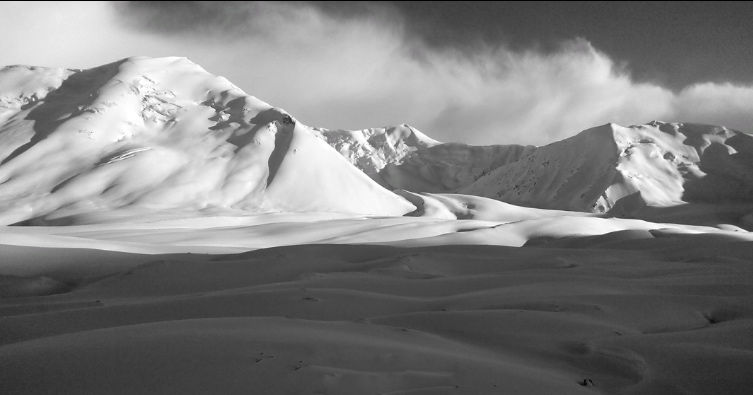
But the weather had been closing in for days, and we were only able to go for one.
That one peak stood just across the glacier — a clean ridge line under the pale light of the moon. We named it Jaksang, “Opportune Time,” because that’s exactly what it was: a small window, a chance. On May 23, around midnight, we left camp and walked quietly across the glacier, the moon hanging low and hazy behind the clouds.
It took an hour to reach the base. From there, we moved up its northeast ridge — firm snow, steady slope, breath after breath. We fixed rope on two steep sections where cornices curled like frozen waves. By morning, we were standing on the summit at 6,152m. No views, no fanfare — just a deep, thick silence and the knowledge that we had reached what we came for.
After the descent, we still had one more test: a long march across moraine to reach the next camp. The rocks were unstable, endless, and each step with heavy loads felt like a negotiation with gravity. That night, we collapsed in our tents knowing we’d earned every second of rest.
It was our third summit. The last of this expedition. Jaksang didn't come with blue skies. It came with humility. It reminded us that even one peak, if met at the right time, is more than enough.

🏔️ Crossing Kunzang Col: The Final Trek Into Rongdo Valley
After Jaksang, the mountain gave us no more. The snow deepened, the wind turned cruel, and we knew it was time to move on. We crossed the main glacier and camped beneath Kunzang Col, at around 5,446 meters. That night, the storm came heavy — nearly 80 centimeters of fresh snow. By morning, it felt like the world had been reset.
Climbing to the col the next day was slow and unforgiving. Every step sank to the thigh. It took us nearly three hours to cover what would normally be a short pass. At the top — around 5,800 meters — there was no view, just white silence and the effort it took to stand in it.
We rappelled down the other side, dropped onto a new glacier, and began the long descent. Below us was Island Peak, a quiet sentinel we’d explored from a distance.
By now, our loads felt twice as heavy and the moraine underfoot was relentless. Every rock shifted. Every step was work. But just as exhaustion began to wear down the spirit, we saw it: steam rising from the rocks ahead.
🌋 Unexpected Reward: A Natural Hot Spring Amidst Karakoram Snowfields
Near the end of the expedition, we reached a hidden hot spring. It felt surreal to walk out of snowstorms and into warmth.. We built a small pool with rocks and soaked in warm, mineral-rich water while snow lay quietly all around.
It was the kind of moment that reminded us why we come to the mountains: not just for the summits, but for the small, human joys tucked between extremes.
🌿 Descending Into Rongdo: Returning to Green After a Month in the Mountains
From the hot springs, our route wound down along ancient herder paths. The snow thinned. Grass began to appear in soft patches — cautious at first, then more bold. After weeks of white and grey, even the smallest sprout of green felt almost unreal.
We passed through Rongdo Phu, a high summer settlement where villagers bring their animals to graze. Stone corrals, simple shelters, and the faint smell of yak told us we were nearing life again. Below, the valley began to open — soft curves replacing jagged ice, willow fences lining the trail.
By the time we reached Rongdo village, the silence we had grown used to was broken by sounds of village life. We had entered another world — not lesser, just different.
The journey was over. But the stillness of those peaks, the fire of the climb, and the bond we forged out there — those things stayed, stitched quietly into the body and memory.
🤝 Teamwork in the Karakoram: The Lifeline of Any High-Altitude Expedition
If there’s one thing the Karakoram demands — besides endurance — it’s trust. Out here, no one climbs alone, even if the summit moment feels solitary. Every success, every close call, and every ounce of safety hinged on the people beside me.
From holding a rope during a crevasse fall, to silently sharing the burden of a 3km frozen lake with 30kg on your back, to making decisions in a storm at midnight — teamwork in these mountains is not the kind you shout about. It’s quiet, intuitive, and often unspoken. It’s knowing someone will watch your crampon straps when your fingers are too frozen, or step in when your energy runs thin. It’s making space for each other’s weaknesses and never celebrating alone.
In the high, cold spaces where ego doesn’t survive, teamwork becomes the true rope between people — invisible but unbreakable.
And perhaps that’s the real summit we reached out there.
🏔️ Reflections From a Mountain Guide: What the Karakoram Taught Me
I came to climb eight peaks.
I returned with three summits and a lifetime of stories.
The Karakoram taught me about trust, cold, gravity, pain, silence, and the beautiful futility of trying to define success by numbers. The real victory was simply to be there — in the forgotten valley of Shukpa Kunzang, where few have walked and fewer have stood still.
This expedition gave me something greater than summits — it gave me stories no map records, memories no altitude can erase, and a deeper reverence for this ancient land.
__________
To walk where no one has walked, to name no peak, but to know it deeply — that, to me, is a summit in itself.
Comments